
When LLMs deliberate with each other
Bias, identity and exclusion in multi-agent systems. What happens when several language models stop talking to you and start talking among themselves.
What happens when several language models are not talking to you but to each other? When LLMs stop being assistants and become participants in a structured debate, instantiated with different social identities, with their own cognitive biases, their own fears and their own vocabulary?
That is exactly what we have explored over the past months with Omnibrain, a multi-agent deliberation framework designed to simulate debates between LLM agents with rich, differentiated social profiles. The result has not been just a technical experiment: it has been a mirror. And what that mirror reflects about how these models think —and how they fail— deserves attention.
This article is not a summary of the academic paper. It is a tech-ethics reading of what happens when we set deliberating machines that simulate people. And what that tells us about ourselves.
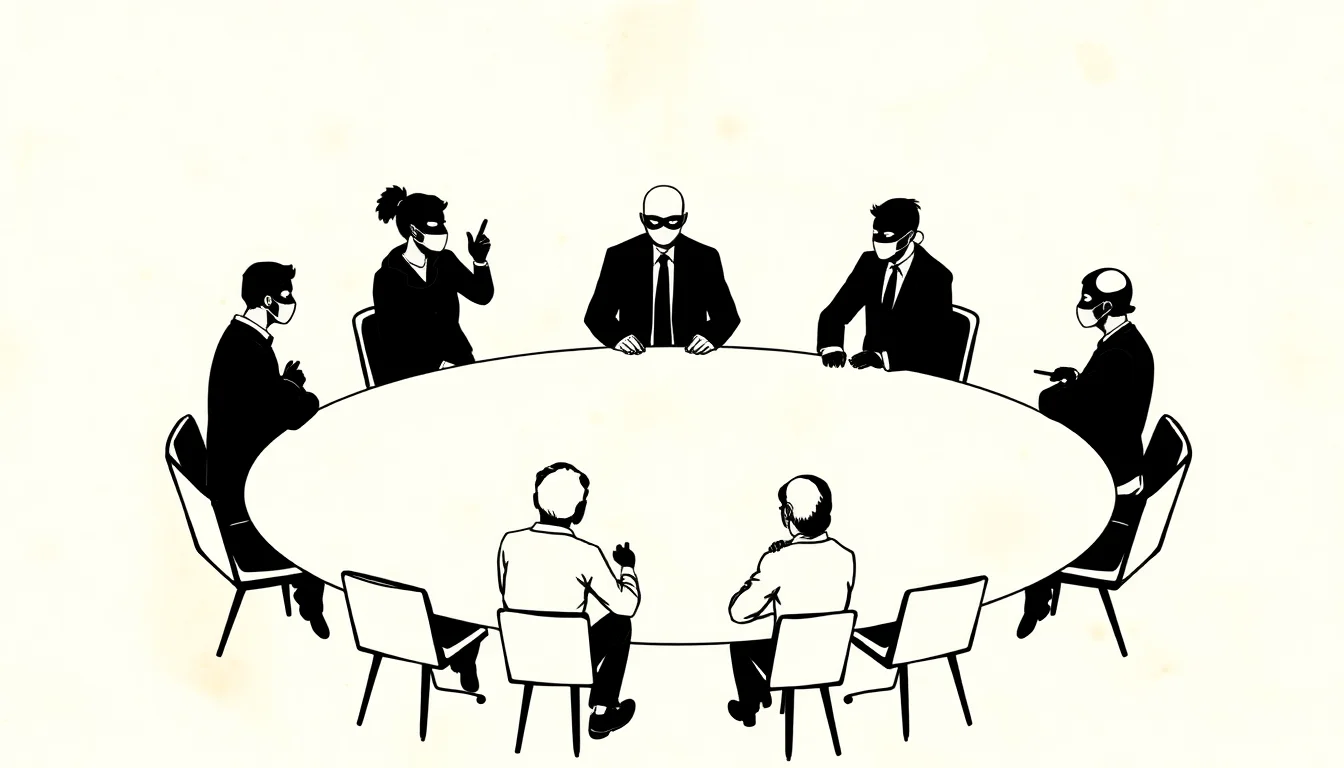
The experiment: ten voices, one question, three different structures
The central question was direct: will AI-driven automation lead to a sustainable labour transformation or to a deeper structural inequality?
To answer it, we built three phases of debate:
Phase 1 — Expert panel (Claude): 7 analytical agents —risk manager, legal advisor, journalist, fact-checker, trend analyst…— debated with visible identity. Result: unanimous approval 7/0. Structural inequality as conclusion.
Phase 2 — Identified social panel (DeepSeek Reasoner): 10 richly defined social profiles —David the precarious freelancer, Remedios the rural farmer, Hugo the digital teenager, Amina the immigrant worker, Paco the retiree…— debated with their names visible. Result: rejection 7/3. The abstract solutions of the experts, rejected as insufficient.
Phase 3 — Anonymous social panel (same model): The same 10 profiles, but without identity labels. No one knew who was who. A known but hidden fact-checker acted as epistemic deterrence. Result: approval 9/1. Concrete, actionable proposals.
Same model, same profiles, different structure. Three radically different results. That is, in itself, a fundamental observation about how the design of deliberation determines its conclusions.
Eight patterns no one programmed
The most revealing thing about this experiment was not the final result of each vote. It was what emerged without having been designed. Eight patterns that the models generated on their own, from the interaction.
| Observed pattern | What happens | Origin | Evidence |
|---|---|---|---|
| Identity leakage | Vocabulary reveals who you are even if the name is hidden | Partial (prompts define style) | 50.5% unique vocabulary per profile |
| In-group moderator bias | Each agent proposes a moderator that resembles itself | Emergent | No prompt instructs self-similarity |
| Actionability inverse to expertise | The most vulnerable profiles generate the most implementable proposals | Emergent | 0-6 month timelines vs. 12+ months from experts |
| Convergence on physical presence | Three distinct profiles arrive independently at the same principle | Emergent | Immigrant + Rural + Retiree → same right |
| The expert as notary | Experts validate, do not persuade; street profiles prescribe | Emergent | 7/3 rejection of experts in Phase 2 |
| Epistemic regression | Exposure to vulnerable testimonies triggers retreat to the individual | Partial | Antonio: collective fund → individual protocol |
| Self-correction as integrity | Only the fact-checker corrected its own claim | Possible model artefact | 1 out of ~90 total arguments |
| Structural exclusion | The debate format reproduces the exclusion it studies | Partial + emergent | Remedios votes NO though she agrees |
Worth pausing on some of them.
1. Vocabulary as fingerprint
In Phase 3, the agents received explicit instructions not to reveal their identity. No one could see the role labels of the others. But the anonymisation was an illusion.
David the freelancer mentioned Fiverr, Upwork and hourly rates in his first argument. Elena the civil servant cited Law 19/2013 and proposed a Commission of the Transparency Council assisted by INCIBE. Hugo the teenager used Discord server and CapCut slang. Amina spoke of jobs obtained by WhatsApp and verification systems that fail with her hijab.
50.5% of each profile’s vocabulary was unique —used exclusively by that agent and no other. The teenager reached 59.4% lexical uniqueness.
The leakage was not just thematic. It was syntactic. The bureaucratically precise language of the civil servant, the anglicisms of the freelancer, the youthful slang of the teenager. Vocabulary is identity. And identity cannot be anonymised with labels.
This has implications far beyond the experiment: any anonymous deliberation system —human or synthetic— that depends on anonymity to reduce hierarchies must assume that language reveals what the name does not.
2. Propose a moderator: the bias without mirror
In the first round of Phase 3, before any substantive debate, we asked each agent to propose who should moderate. No one knew who anyone was.
The freelancer proposed a data journalist specialising in platform economy. The corporate executive, a former COO of digital transformation. The civil servant, a Commission of the Transparency Council. The rural woman, a rural schoolteacher or a nurse touring villages. The teenager, someone young with experience in online communities.
Every agent proposed a moderator that resembled itself. Without knowing. Without seeing. The conception of ‘who is fair’ was shaped, in each case, by the agent’s own identity.
Computational naive realism: the belief that our perspective is the objective one. It does not take consciousness to reproduce it.
3. The most vulnerable, the most concrete
Here is one of the most counter-intuitive findings of the experiment: agents with the most precarious profiles and the least institutional resources generated the most implementable proposals.
Amina proposed ‘Future Windows’: diagnosis based on real Spanish level, old phone, one free hour a day. Small groups with childcare in the same building. Certificates with QR viewable on the phone. Timeline: weeks.
Remedios proposed a ‘Digital Disconnection Tax’: if a company digitises an essential service, it must maintain in-person access funded by a percentage of its savings.
Paco proposed ‘Transition Offices’ in libraries, health centres and municipal buildings, with existing European funds. Timeline: months.
Expert agents, in contrast, proposed observatories, standardised indices, monitoring platforms. Horizon: more than 12 months.
Perceived urgency acts as a cognitive accelerator. Those facing immediate threats generate solutions calibrated to real constraints.
If this is confirmed with repetitions, it has direct implications for how contributions should be weighted in real deliberative processes: not only by analytical rigour, but by proximity to impact.
4. The convergence no one orchestrated
Three distinct profiles —the immigrant, the rural woman, the retiree— arrived independently at the same political principle: physical human presence as a non-negotiable right in any digitised service.
No prompt instructed this. None of the three profiles shared motivational framework: Amina saw it from language barriers and opaque bureaucracy, Remedios from rural isolation and structural disconnection, Paco from the dignity of the worker who knew clients by name.
The convergence emerged from the collision of three different experiences of exclusion. No expert, no executive, no digitally fluent teenager proposed anything similar.
Perhaps because those who have not been excluded cannot imagine the need for the button that says: ‘speak to a person’.
5. The expert does not persuade: certifies
In Phase 2, the social profiles rejected 7 to 3 the experts’ diagnosis. Not because it was wrong —it was not— but because it did not offer a path forward that included them.
In Phase 3, however, seven out of eight profiles cited the research analyst’s Observatory proposal as ‘the most technically sound’. Not because it had convinced them. But because it was perceived as the most neutral.
The expert did not persuade; served as the notary who certified what street people already knew. The data ended up confirming lived experience rather than contradicting it.
This is consistent with the argumentative theory of reasoning by Mercier and Sperber: we argue to defend positions, not to seek truth. Expertise does not persuade by its rigour, but by its perceived neutrality.
6. The debate format excludes whom it claims to include
The only rejection in Phase 3 was Remedios’. And it was not ideological. She agreed with the diagnosis, understood the proposals, but voted against.
“All proposals start from a world that is not mine.”
Every proposal assumed internet connectivity, smartphone access, digital literacy, institutional proximity. Conditions not met in her reality. The debate on digital exclusion reproduced the digital exclusion it claimed to study.
This observation is reflexive: it points to the experimental design itself. A text-based, multi-round debate that requires articulated written argumentation privileges the literate, the connected, the institutionally readable. Even the most carefully crafted persona prompt cannot overcome the structural bias of a medium that excludes the very populations it simulates.
What does this tell us about how LLMs work?
These eight patterns are not system failures. They are emergent properties of how language models process identity, vocabulary and deliberative context. And each of them illuminates something about the nature of these models.
LLMs cannot anonymise themselves. Identity leakage shows us that the vocabulary of an agent instantiated with a specific social persona is not separable from that persona. Communication style, cultural references, lexical biases are constitutive of how the model generates text from that role. This has direct technical implications: if you want real anonymity in multi-agent deliberation, hiding labels is not enough. You need vocabulary normalisation, style transfer, or format redesign.
Identity instantiation amplifies human biases. The in-group moderator bias, Antonio’s epistemic regression when faced with vulnerable testimonies, the moral superiority of each agent over the others: these are patterns we recognise in human deliberation. LLMs, when simulating people with defined biases, do not attenuate them. They amplify and systematise them. As Gupta et al. (2024) documented: models exhibit ‘hyper-stereotyping’. They amplify group-level patterns beyond what real members of those groups exhibit.
Deliberative structure is an argument in itself. The shift from 7/3 rejection (Phase 2) to 9/1 approval (Phase 3) with the same profiles and same model shows that the conclusions of a deliberation depend not only on who participates, but on how participation is organised. Debate format is a political choice, not a technical one.
Generative epistemology: knowledge that emerges from interaction. The spontaneous convergence on physical presence as a right, the freelancer’s observation about ‘paying for the tool that makes me expendable’, Remedios’ demand for a ‘speak to a person’ button: none of these insights was in any individual agent’s prompt. They emerged from the collision of perspectives that the debate format allowed. In this sense, multi-agent deliberation functions as a generative epistemology: it produces knowledge that no agent —and no human— would produce alone.
Tech-ethics reflection: the mirror that deliberates
What if the important question is not whether AI agents can deliberate like humans, but whether their deliberation can teach us something about how humans fail to deliberate with each other?
Our observations are consistent with the possibility that it can. And what emerges is not flattering.
The impossibility triangle they found on their own. The expert panel of Phase 1 independently derived what we call the Impossibility Triangle of AI Labour Transition: it is not possible to simultaneously maintain (1) maximisation of corporate benefit through AI, (2) sustainable labour transition, and (3) absence of strong regulatory intervention. Only two of the three are compatible.
The current global configuration —corporate maximisation without strong regulation— structurally eliminates the sustainable transition. Not as an accident, but as a logical consequence of the incentive system.
The panel estimated a preventive intervention window closing between 2027 and 2029.
The voice that cannot speak in the format that studies it. Remedios’ rejection is the most honest moment of the experiment. A debate on digital exclusion that requires written argumentation, internet connection and digital literacy to participate reproduces in its design the exclusion it purports to study. This is not just a problem of our experiment. It is a structural question for any deliberative system that depends on digital formats to include those excluded from the digital.
Synthetic ventriloquism as ethical risk. There is a real risk that multi-agent deliberation will be used as a substitute for genuine citizen consultation —allowing institutions to claim they ‘consulted diverse perspectives’ without involving real people.
Simulating the voice of an elderly rural woman is exactly that: a simulation. No member of the represented populations was consulted. Persona prompts are constructs of the researcher’s assumptions, filtered through the model’s training data.
Multi-agent deliberation should be a complement to human consultation, not a replacement. Its value lies in revealing structural dynamics and blind spots that inform the design of real consultative processes. Not in substituting them.
The actionability paradox. Perhaps the most disturbing finding from a tech-ethics perspective is this: the most excluded voices produced the most implementable proposals, while experts produced the most rigorous diagnostics.
If this is confirmed, it suggests that current deliberative systems —designed to listen to experts because they have the correct institutional language— may be systematically filtering out precisely the most useful knowledge: that which emerges from those who live closest to the problem.
“We know what is happening, we know what is coming, and we are not doing anything proportional to the scale of the problem. That is the story. And we are not telling it well.” —as the journalist agent of Phase 1 put it.
Conclusion: a system that shows what we do not want to see
Omnibrain was not designed as an oracle. It was designed as a diagnostic instrument. And what it diagnoses, when multiple LLMs deliberate with each other with differentiated social identities, are exactly the same dynamics of exclusion, hierarchy and bias that operate in human deliberation.
With a difference: here they are visible. Measurable. Replicable.
That vocabulary is a fingerprint, that the ideal moderator always resembles whoever proposes them, that the most vulnerable generate the most concrete proposals, that the debate format excludes whom it claims to include: none of this was programmed. Everything emerged.
And that invites us to a final question, which is not technical but political:
If the systems we design to deliberate reproduce the same exclusions they claim to study, shouldn’t we start by redesigning the systems, not just the models?
Without epistemic infrastructure, all legal, economic and technological solutions are left with no ground to stand on.
The work continues. Ablation studies, replication across models, validation with real human participants. But the questions are already open.
What kind of deliberation do we want to build? And whom are we willing to truly include in it?
References
- Acuña Godoy, S. (2026). Simulated social deliberation: A multi-agent framework for studying AI bias, identity leakage, and epistemic inequality in structured debates. Zenodo. doi.org/10.5281/zenodo.18963315
- Omnibrain framework and full debate transcripts: gitlab.com/saulfacunag/research
- Argyle et al. (2023). “Out of one, many: Using language models to simulate human samples.” Political Analysis.
- Gupta et al. (2024). “Bias amplification in LLM persona generation.” FAccT 2024.
- Mercier, H. & Sperber, D. (2011). “Why do humans reason?” Behavioral and Brain Sciences.
- Park et al. (2023). “Generative agents: Interactive simulacra of human behavior.” UIST 2023.
- Sunstein, C. R. (2002). “The law of group polarization.” Journal of Political Philosophy.
- Tessler et al. (2024). “AI can help humans find common ground in democratic deliberation.” Science.
- Ross, L. & Ward, A. (1996). “Naive realism in everyday life.”

